
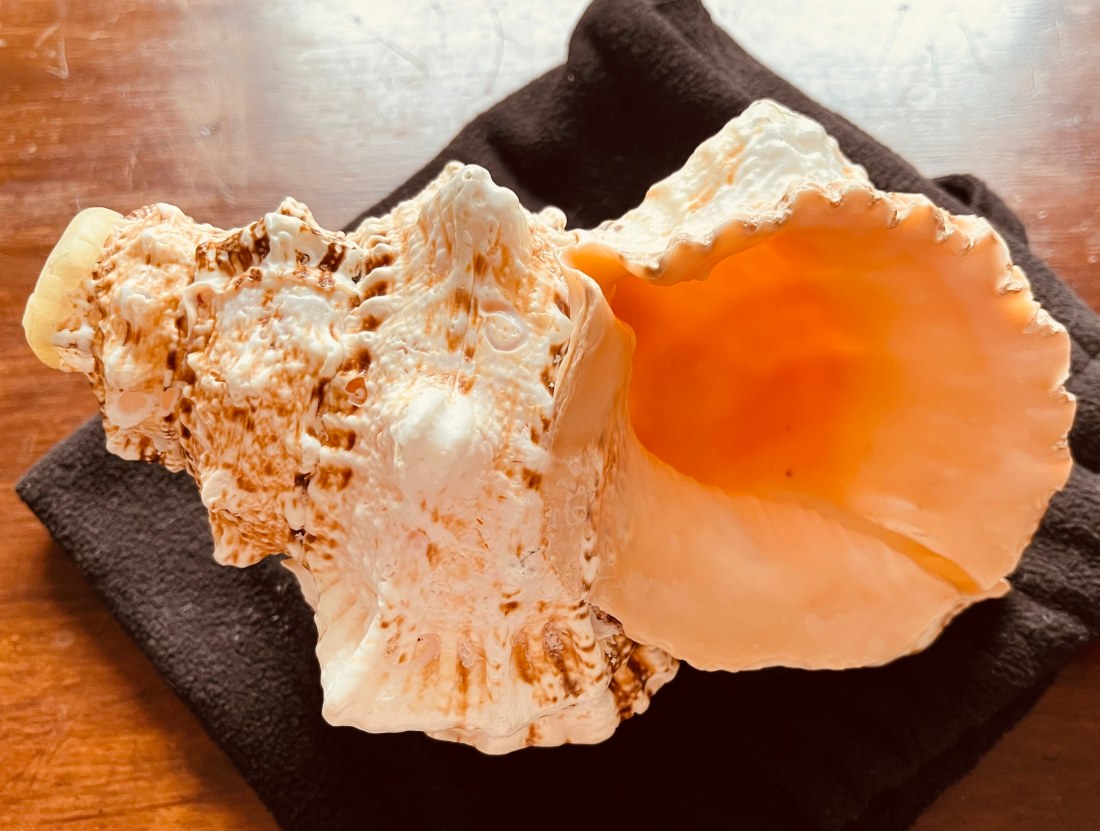
I’m the delighted custodian of a beautiful conch shell trumpet gifted to me by Marco Blaauw.
This is one of two conch shells used in a Creators’ Lab workshop that I led at the Klangspuren Festival in mid-September. I invited participants to cultivate relational pathways with the shells, which generated a rich range of responses around attention, reverence, and modes of address. Through shifts in bodily posture, kneeling, standing, modulating distance and proximity, and other sensory shifts: defocusing the gaze, and working with voice and sound, participants explored how relational space might be altered and deepened. These acts of opening yielded some unexpected insights and encounters; various “messages” seemed to arrive through the process, surprising all of us in the room.
This particular shell is associated with a pivotal moment of insight in my work with Marco. When I sounded it in a rehearsal room in Berlin in March 2025, I felt it reorganise and retune my body, bringing me into resonance with both the shell’s acoustic properties and those of the surrounding space. The experience revealed to me the power of a cultural artefact as an active agent, capable of opening pathways across time, space, memory, and embodied experience. In such moments of resonance, the distinction between doer and doing begins to dissolve. We are not simply shaping the world; we are simultaneously being shaped by it, participating in a co-creative relationship.
I’m interested in working with such vectors of exchange and transformation. This underpins a long-standing engagement with the ritual architecture of altars and offerings as thresholds, way stations, and portals into a ceremonial register of experience. These structures can enable forms of heightened communication between performers and audiences, ancestors and spirits, and other more-than-human presences. Works exploring these ideas include Sex Magic (2020), with its altars of shells, flowers, and bells activated by transducers; and the offerings that marked the opening and closing of the Eigenthal-Rümlig River collaboration Multispecies Knots of Ethical Time (2023). Earlier precedents include Moon Spirit Feasting (2000), a Chinese ritual street opera I created with librettist Beth Yahp and the ELISION Ensemble, structured through offerings made to an invisible audience of spirits and “hungry ghosts”.
The most recent example is in Tongue of the Land (2026) in which the entrance of the carnyx (played by Marco) is greeted with a gesture of propitiation: the string players of the orchestra are instructed to ’empty their pockets of coins’ as the carnyx comes onto the stage. At the time of composing, I struggled with this instruction as something seemingly crazy. Yet I could not continue composing the work without a gesture of sacrifice to acknowledge the carnyx’s arrival into an unfamiliar space in the present. Sonic, physical and conceptual/spiritual gestures came together in what turned out to be an important moment in the work.
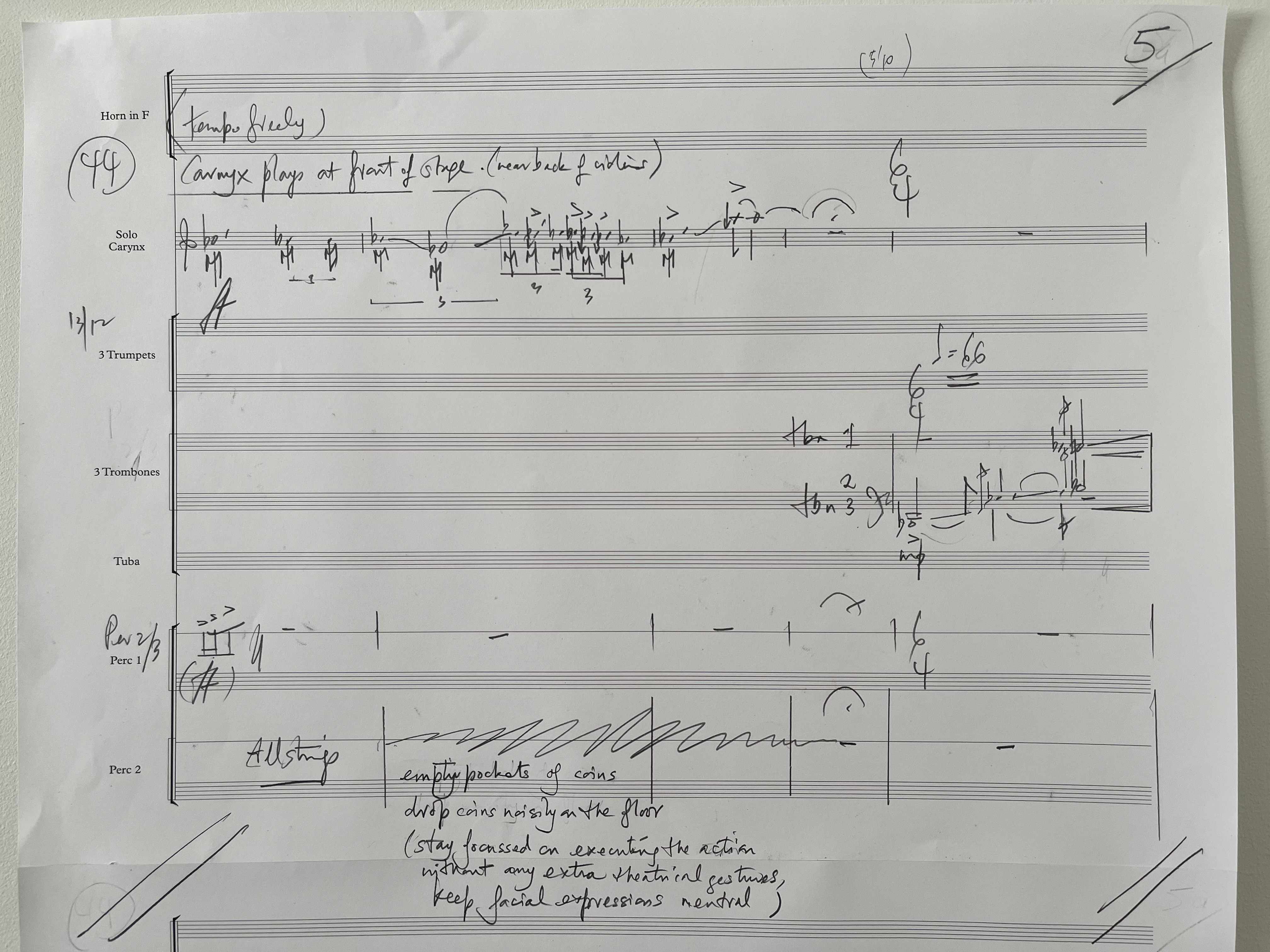
[Excerpt of pencil sketch Tongue of the Land and audio of bars 39-49, flexatones heralding the arrival of the carnyx and the sound of dropping coins; Lucerne Festival Contemporary Orchestra conducted by Peter Rundel, Marco Blaauw soloist on carnyx, Lucerne Festival premiere, 29 August 2026.]
For more information about the research process behind the composition of Tongue of the Land, see the three-part documentary film ‘Je Suis Le Carnyx’ https://www.youtube.com/playlist?list=PLFPvDf6paoBE

