
I recently finished composing Tongue of the Land, a concerto for orchestra with carnyx.
Commissioned by Roche as the 13th Roche Commission for Lucerne Festival, the world premiere is later this year at the Lucerne Summer Festival on August 29th with the Lucerne Festival Contemporary Orchestra conducted by Elim Chan and soloist Marco Blaauw playing a carnyx recreated by master coppersmith Jean Boisserie.
The work is divided into 3 sections:
- Beginning: Eros of disruption
- Middle: time codes
- The Beginning: Parliament of Beings
program note:
The land has everything it needs. But it couldn’t speak. It couldn’t express itself. Tell its identity. And so it grew a tongue.
That is the Yolŋu. That is me. We are the tongue of the land.
Grown by the land so it can sing who it is. (Djambawa Marawili)
The dead are not absence; they are the mouth of the earth. (Sofia Batalha)
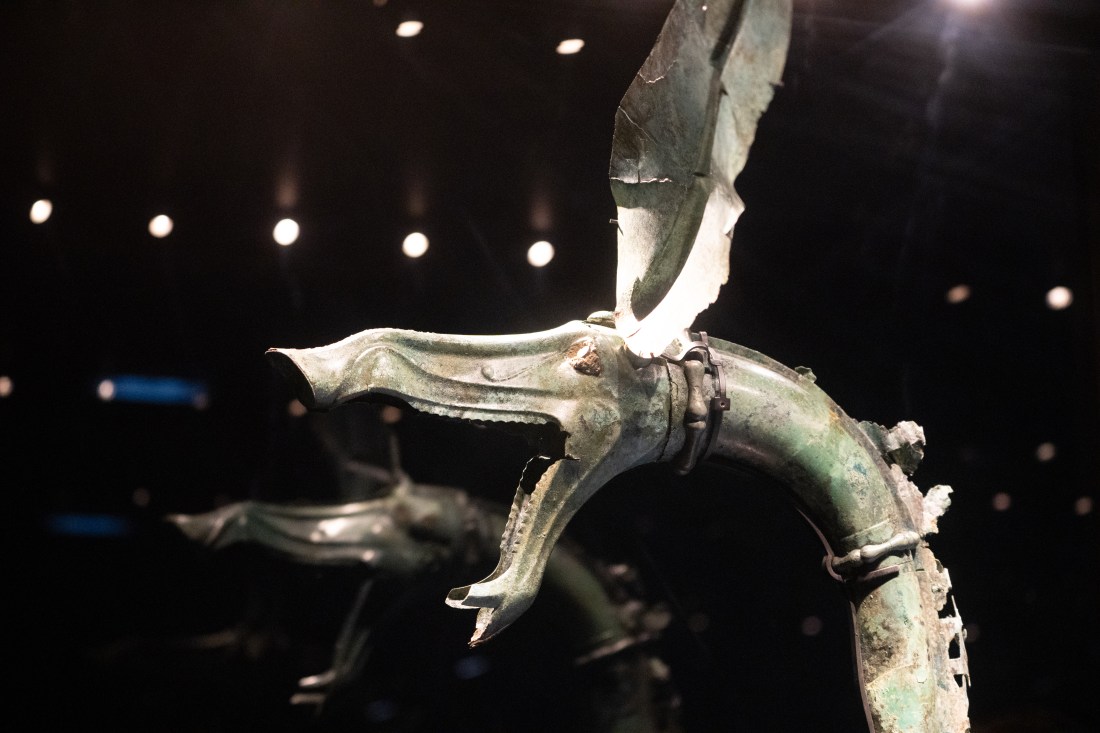
Tongue of the Land re-awakens the spectacular Celtic boar-headed bronze trumpet, the Tintignac Carnyx.
This is a kind of ‘de-extinction’ project that also brings up difficult questions:
How do ancient lineages of human and more-than-human knowing and creativity reside in bodies and cultural artefacts?
In bringing something back, what Deep Time histories and cultural energies are released and with what unforeseen consequences?
What seeds of resilience might appear, and what vectors of risks?
Amid the haunted echoes of extinction, what are the terms of survival in the Long Future?
This instrument lay buried for over 2000 years, having been ritually broken then interred at a Celtic (Gallic) sanctuary around 50 BCE.
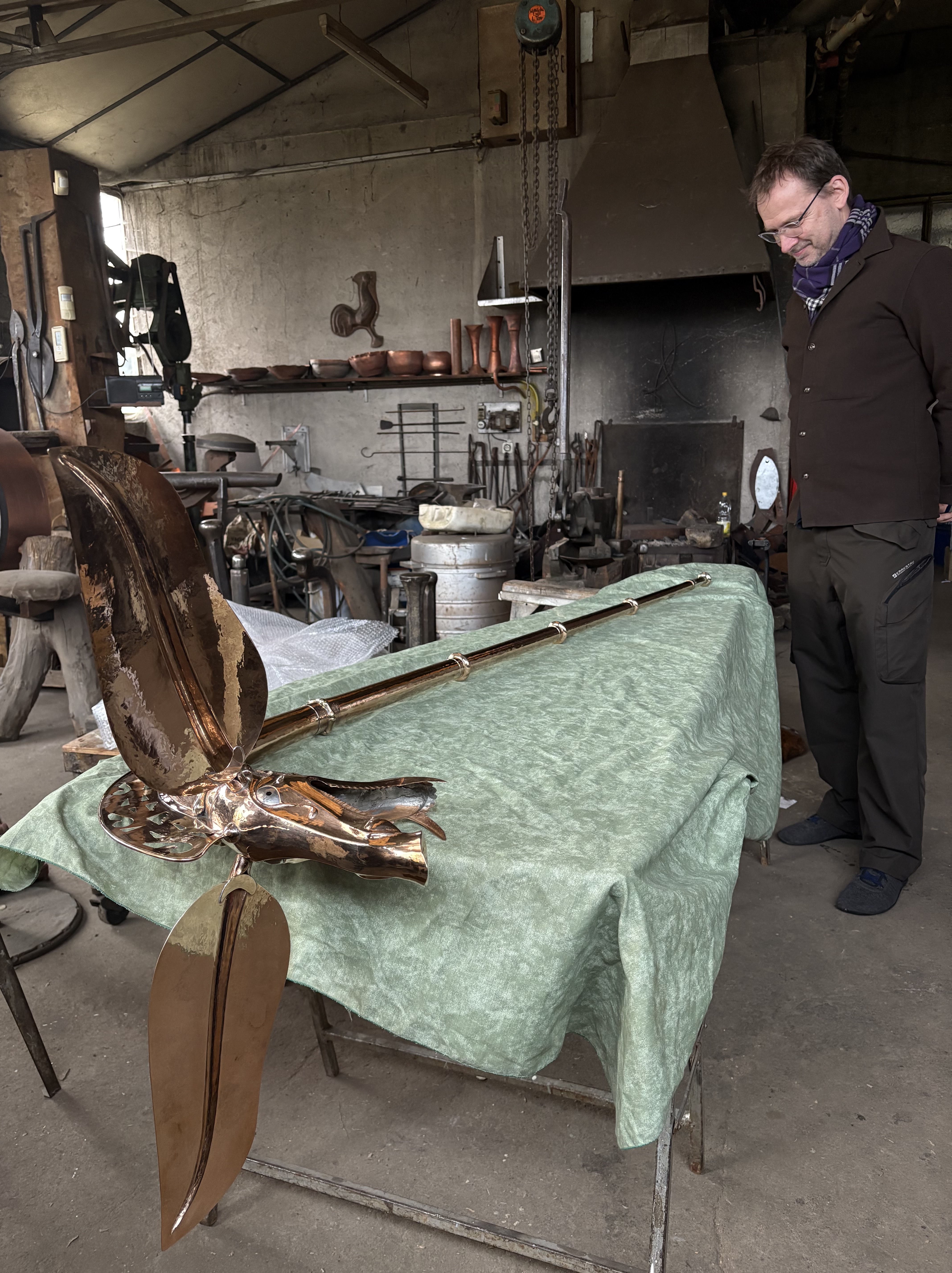
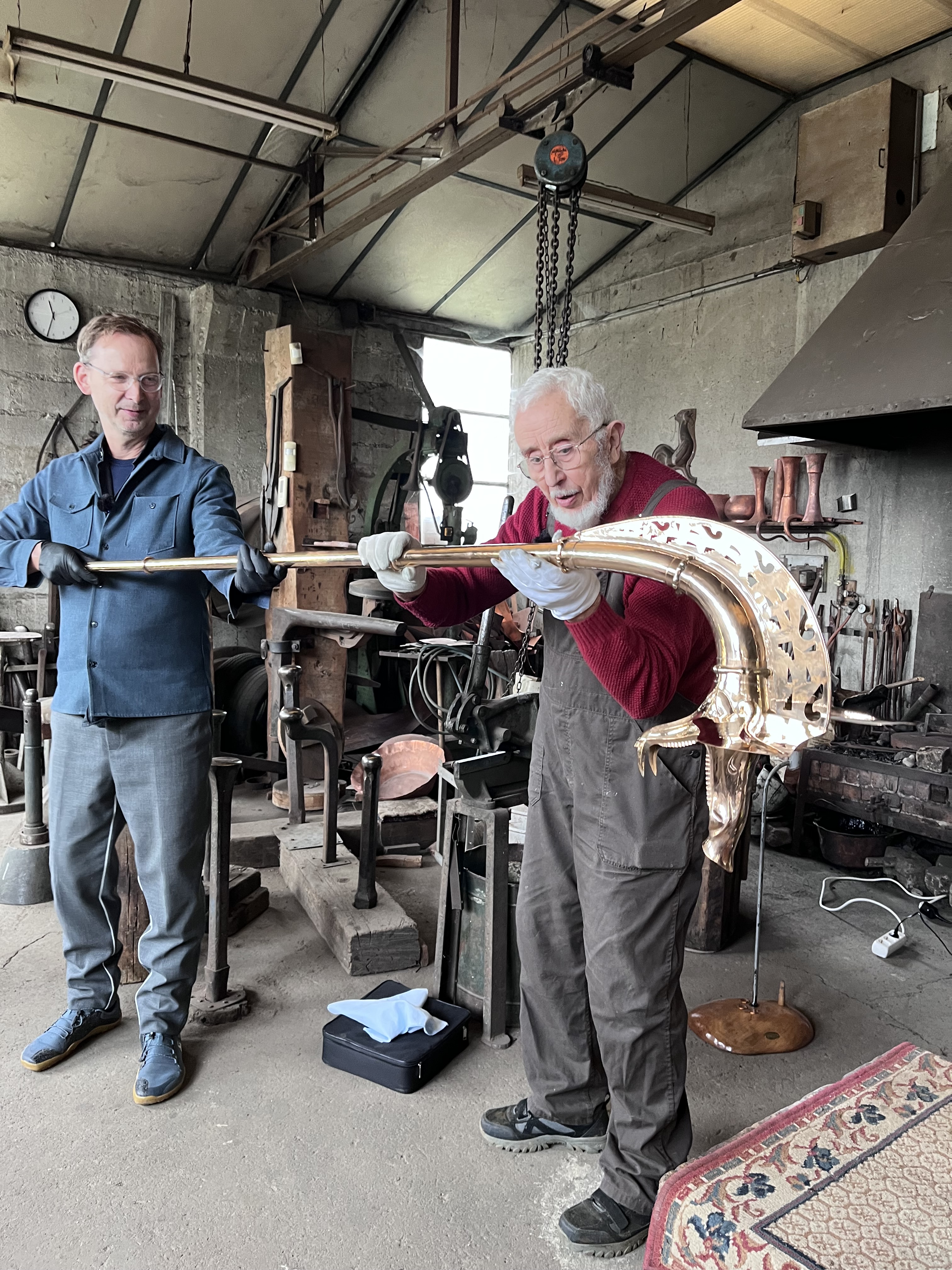
Working closely with trumpeter Marco Blaauw, I delved into findings from the excavation led by archaeologist Christophe Maniquet in which seven carnyces were discovered at a Gallo-Roman fanum (temple complex) in 2004 at Tintignac, near Naves, Corrèze, in the South of France. The discovery reset our understanding of the carnyx which had previously only been known through writings and iconography, and as material fragments. The most complete of these instruments was subsequently recreated by French dinandier (master coppersmith) Jean Boisserie as part of the European Music Archaeology Project (EMAP, 2013-2018).[1] Gaining permission from the City and Mayor of Naves, we were incredibly fortunate and honoured to have M. Boisserie make his 11th carnyx for our project as he approaches 90.
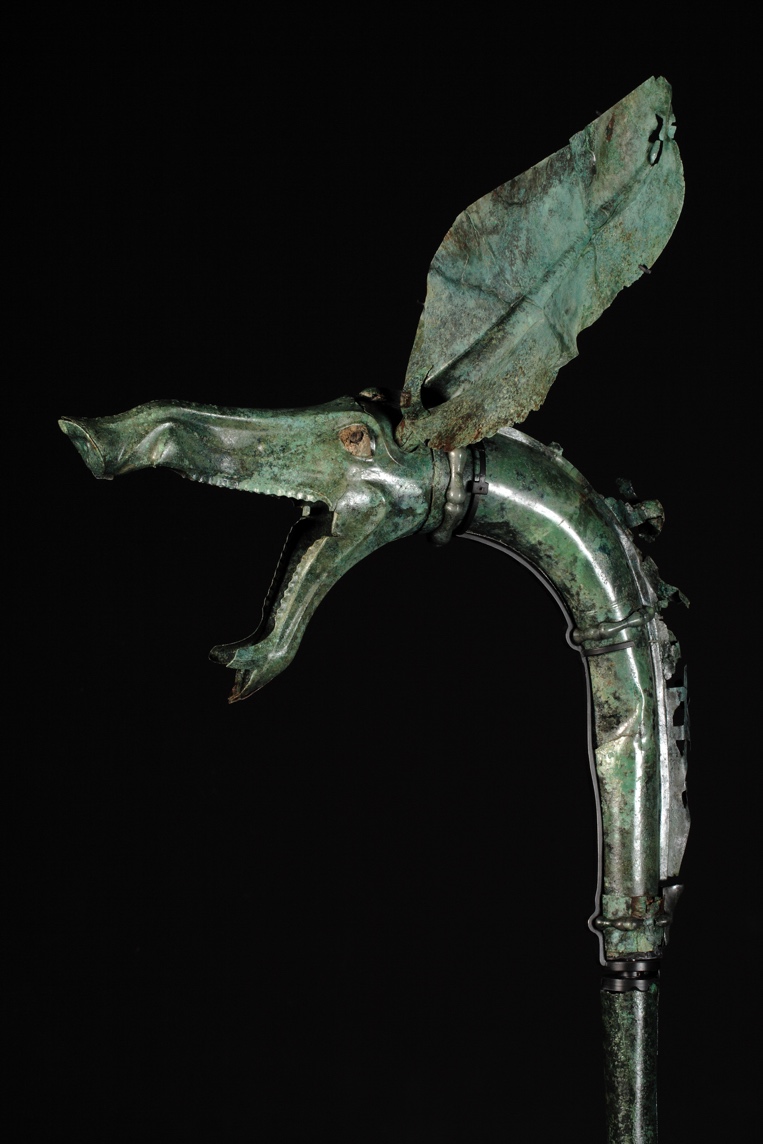
- Tintignac Carnyx, Image Courtesy of Maison du patrimoine, Naves
- Marco Blaauw with newborn carnyx, Jean Boisserie’s workshop, Dec 2025 Photo © Christine Chapman
- Marco Blaauw and Jean Boisserie with Carnyx in workshop, Photo © Janet Sinica
Becoming Carnyx…
The Carnyx is an incredibly charismatic creature with its own wild and unruly sovereignty. It carries the energies of both ascent and descent. Binding with the musician who holds the instrument aloft to play, it gazes across the horizon. Conjoined into a human/more-than-human body-breath-tongue, the carnyx shoots vibrations up into the sky and back down through the musician’s spine into the earth.
To work with this instrument has been to encounter and embrace its unruliness: its disruptive glamour, sense of excess, ferocity and mystery.
Making the composition was humbling, psychically dis-regulating…
There was a process of metabolic attunement to ‘become carnyx’.
I asked: ‘what does Carnyx want?’
Ah… he wants to be propitiated.
He wants to remember the landscape of his birth.
He wants to hear the voices of the Serpent Carnyx and the other carnyces that were also buried in the sanctuary.
He wants to speak…
I took my cue from both Marco Blaauw and Jean Boisserie, in awe of how both gave themselves up to the Carnyx to be instructed in their craft. For Jean, the hundreds of hours spent tapping bronze sheet metal were also a re-tracing of the path of ancient Celtic metalsmiths before him. In this making, a hidden archive of gestures and rhythms comes to life. For Marco, to connect to the voice of the Carnyx means a radical remoulding of the body: head and neck craned back and up, lips sucked into the mouthpiece, and an earthquake of vibrations in his skull and spine. Past-present-future flashes and burns, and there is a reset of time as the Carnyx’s call rings out again.
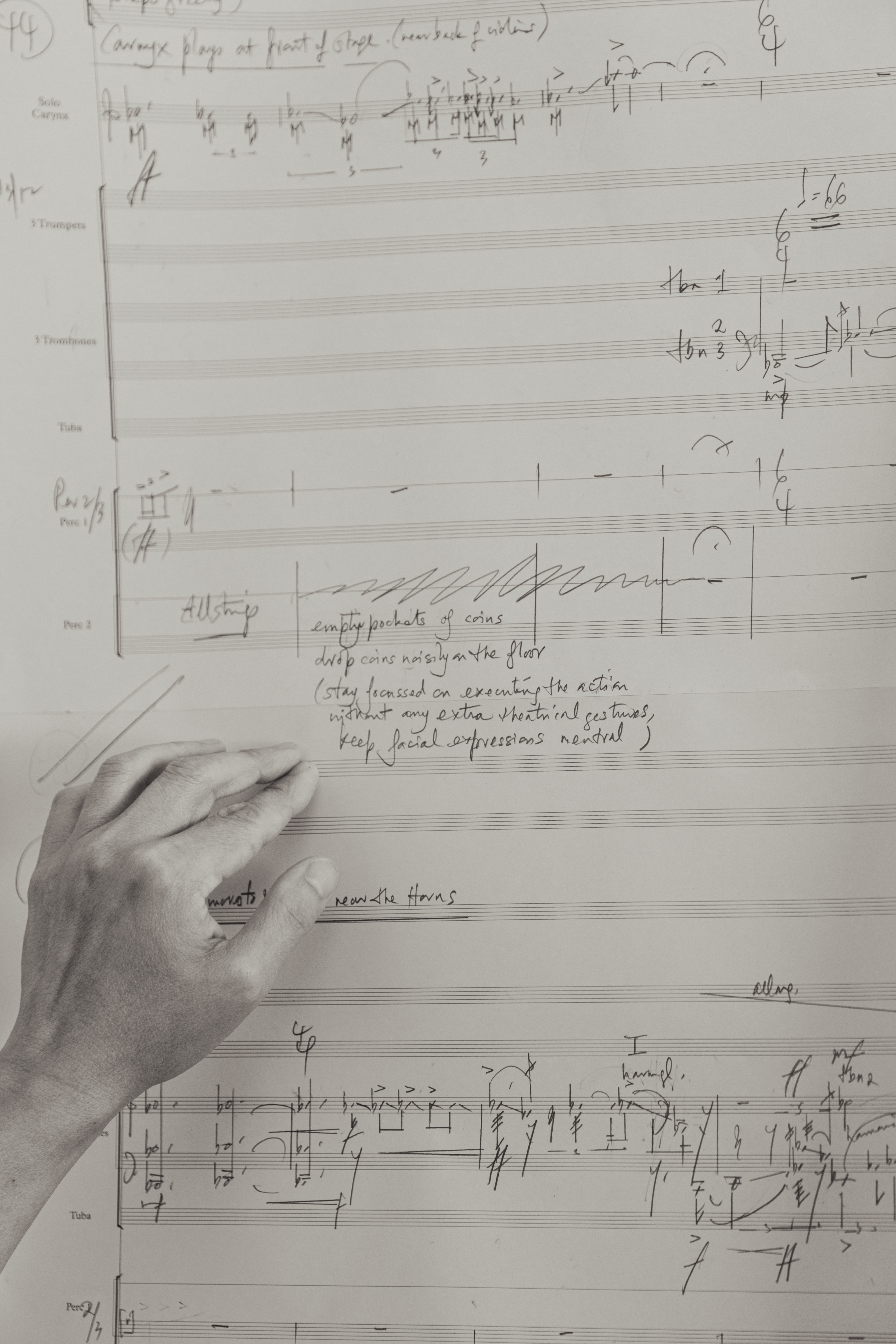
All of these sensate elements come into the work: in the repeated dulled tappings and the wild screaming of out-of-control flexatones; the casting of coins as a gesture of offering; in the incantatory solo voices and the chorusing of the brass; in the wonky resonances of the orchestra looping around, suddenly rising up and dispersing like a swarm.
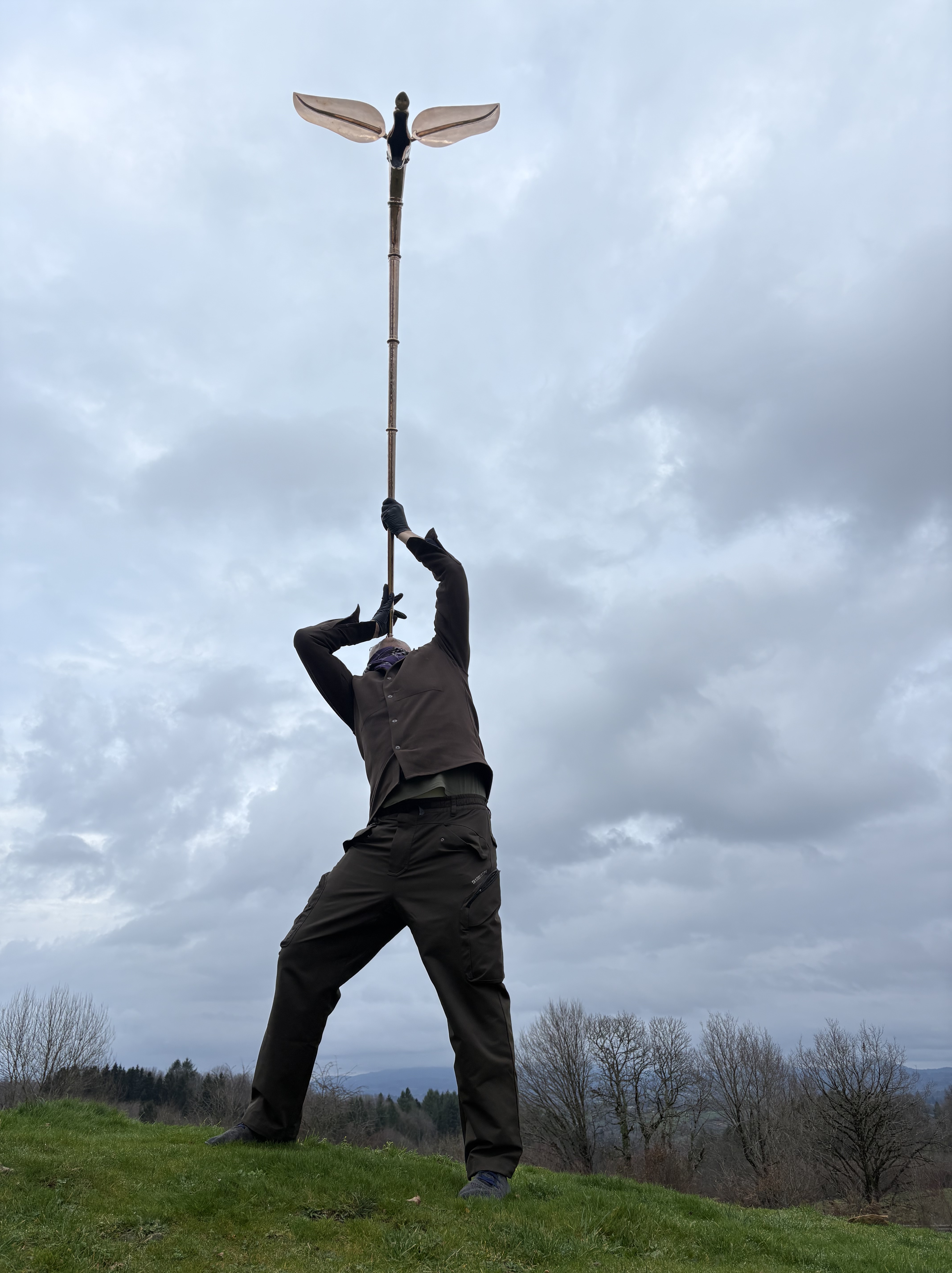
- Marco Blaauw plays the Carnyx at the archaeological site, Tintignac, France, December 2025, Photo © Christine Chapman
- Tongue of the Land, sketch page from score, Photo (c) Fiona Wolf
Marco Blaauw writes that the Carnyx appearing again[2] in the Anthropocene is a call to listen:
“The Carnyx’s return is not nostalgia. It is a challenge.
The instrument is unearthed and appears in a time of growing confusion, polarisation, violence, environmental collapse.
Christophe Maniquet, Jean Boisserie, and we are all in this together.
The Carnyx returned and we create a circumstance for it to speak up.
This animistic instrument, thought to belong to the past, is still present, creating a connection with the world around us here and now.
How do we listen to the land?
How do we collaborate with the more-than-human?
How do we honour its past without romanticising it?
Animism is not just a historical curiosity. It is a living, evolving worldview that offers profound insights into ecology, spirituality, and art.”
The Carnyx is a vector of energetic transformation.
It can teach practices of attention and attunement but those pathways are not pre-formed nor linear.
The Carnyx is a howl across time. Described by Roman historians as an instrument of war and of psychological terror, our knowledge of its other ritual meanings and powers needs to be dreamed.
In the desire to be allies with the more-than-human, Carnyx becomes ancestral kin, inviting us to a migratory reverberation in which time moves backwards and forwards, calling and listening, speaking, singing, sucking and spitting with the Tongue of the Land.
[1] More information : https://www.emaproject.eu/content/instruments/the-carnyx-from-tintignac.html
[2] Quite extraordinarily, an even more complete example of a carnyx was excavated in 2025 in Norfolk, UK : https://www.smithsonianmag.com/smart-news/archaeologists-unearth-ancient-war-trumpet-that-once-struck-fear-in-the-hearts-of-enemies-on-the-battlefield-180987975/
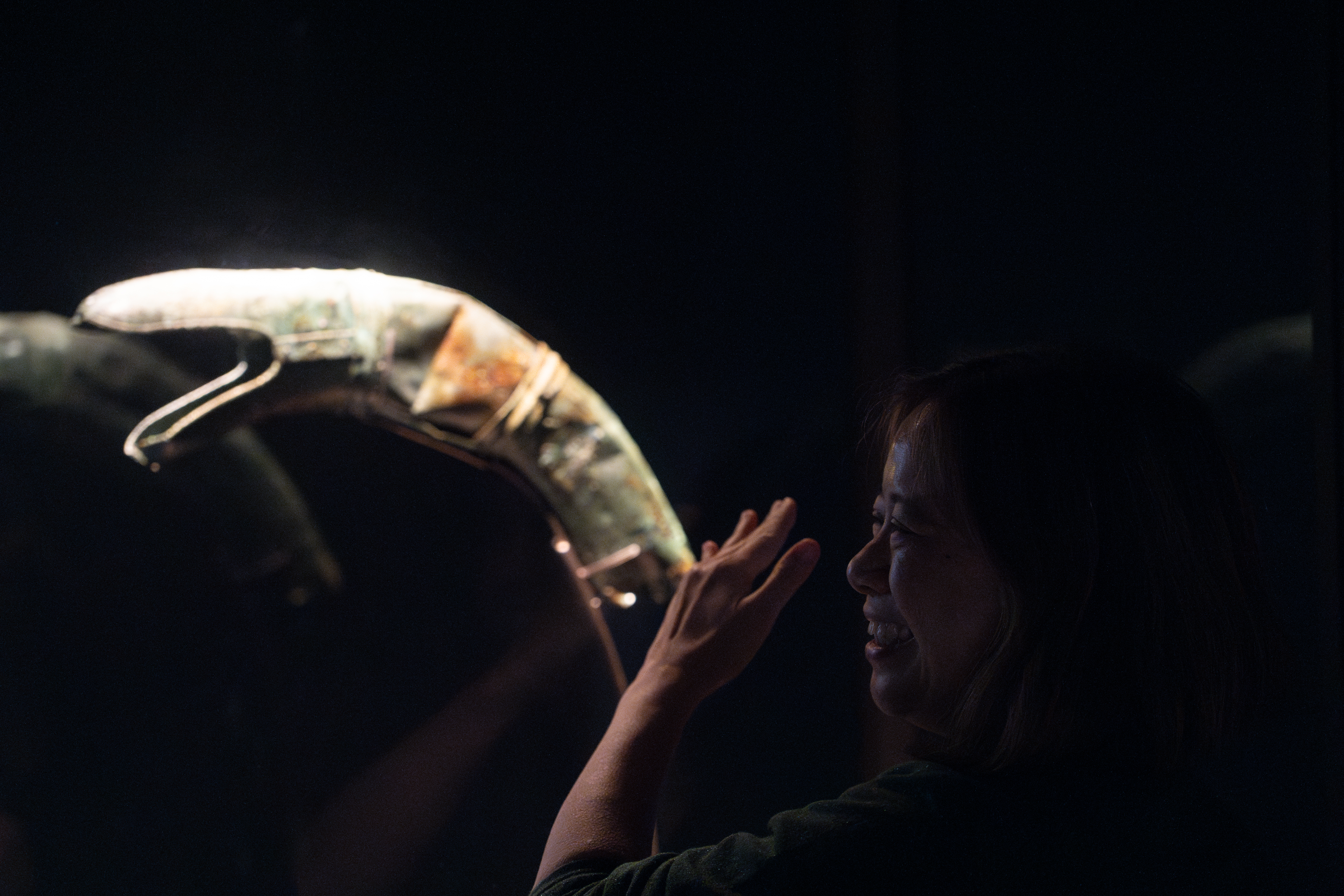
Liza Lim with the Serpent Carnyx, Maison du patrimoine, Naves, France
Photo © Janet Sinica
 Liza Lim