


Composing the last part of Machine for Contacting the dead for the Ensemble Intercontemporain. Apartment in Rue du Temple in the Marais, Paris 1999. (photo: Daryl Buckley)
Here are some rambling thoughts which I’ll keep trying to develop on this blog…this is not always articulate and for sure, not comprehensive, and I’d be interested to hear responses and maybe share thoughts from others if they want to participate in this conversation? (now that twitter is kind of dead…). Click to see comments below from Beth Yahp and Cathy Milliken
17 November 2022, Narrm (Melbourne)/ Kulin Nation
Y’know, I’m pretty sure there’s no way I would have had the opportunities and the career in music I’ve been privileged to have, if I’d been born 5-10 years earlier…
As I said in a talk on gender in music back in 2016, ‘luck’ doesn’t come out of nowhere but is a construction of multiple layers of privilege. I talked about how the ‘luck’ part is just the tip of the iceberg and making change involves tackling the underlying structures. This will often seem counter-factual and crude—quotas, choosing differently, giving up incremental change—because one is attacking ‘how things are’ and ‘how things have always been done’.
Anyway, I’m aware that I stand on so many shoulders and structural privileges as a composer and these things make for massive differential mechanisms over time, that work inter-sectionally in the arts as in other fields. I’m not sure that the pathways that have worked for what I do would have been there even a bit earlier. I’ve had advantages (& also dissuasions) flowing from ancestral/ family lines. Aside from financial privilege in my generation there are some key family ‘stories’ that construct a framework of possibilities, of imaginaries!: the story of resilience and a sense of adventure of migrants from Southern China going to Brunei, Malaysia, Singapore, Taiwan from the 1920s onwards to escape political and economic hardships; the story of female matriarchal gutsiness; the story of the power of education stemming from a line of scholars that was equally embraced within a story of illiteracy.
Then there are my mentors and teachers and their teachers and mentors that opened up lineages of craft and technique in music accompanied by the aesthetic priorities and values of that craft and the artistic ‘scenes’ that those priorities give power to. There was the opportunity of being born in Australia in 1966 as the country began to moderate its racist ‘White Australia’ policies and growing up at a time in which the language and practice of multiculturalism became more nuanced. And the opportunities of developing as an artist in Melbourne in the late 80s and 90s when rent was cheap and there were thriving communities of musicians, poets, theatre-, dance- and visual arts- practitioners who spoke to each other.
So, there are many specificities of time and place in my story (as there will be for everyone): histories and communities that have set up ‘engines’ of possibilities and in which local cultural blindspots and blockages were also incredibly generative in the ways that they led me to a very early engagement with artistic practices and musicians elsewhere, particularly in Germany, Italy, the UK and France. I was always hyper-aware as the child of migrants of being a ‘guest’ in every place I found myself which set me on a course of artistic and intellectual enquiry and personal development that I think can be seen rather clearly in the kind of music that I make with its concerns with ritual (how does one make sense of and placate unknowns?), with transcultural exchange (how does one meet and translate meaning and where are those things held in bodies, voices, objects, practices, places? and in all those musical places of inflection, timing, gesture and rhythm?); with ecology and ethics (I live and work on colonised/stolen Indigenous lands in Australia within a political system where there is virtually no practical regard for an Indigenous ethics of land-sovereignty and the meaning of Country as an all-encompassing interconnection between people, animals, land, sea, air, time, desires, art and responsibilities etc). Of course Indigenous people have long been leading the fight and doing the work to shift this and I love how song is at the centre of right relations and ethics in their communities.
_______________
Beth Yahp
Some comments follow from friends with whom I’ve woven conversations about art, music, life, over time. First up: Malaysian/Australian writer Beth Yahp who wrote the libretto for my second opera Moon Spirit Feasting that premiered on a barge floating on the Torrens River at Robyn Archer’s 2000 Adelaide Festival. Produced and performed by the ELISION Ensemble, the opera was directed by Michael Kantor, conducted by Simon Hewitt, starring singers Deborah Kayser, Melissa Madden Gray and Orren Tanabe.
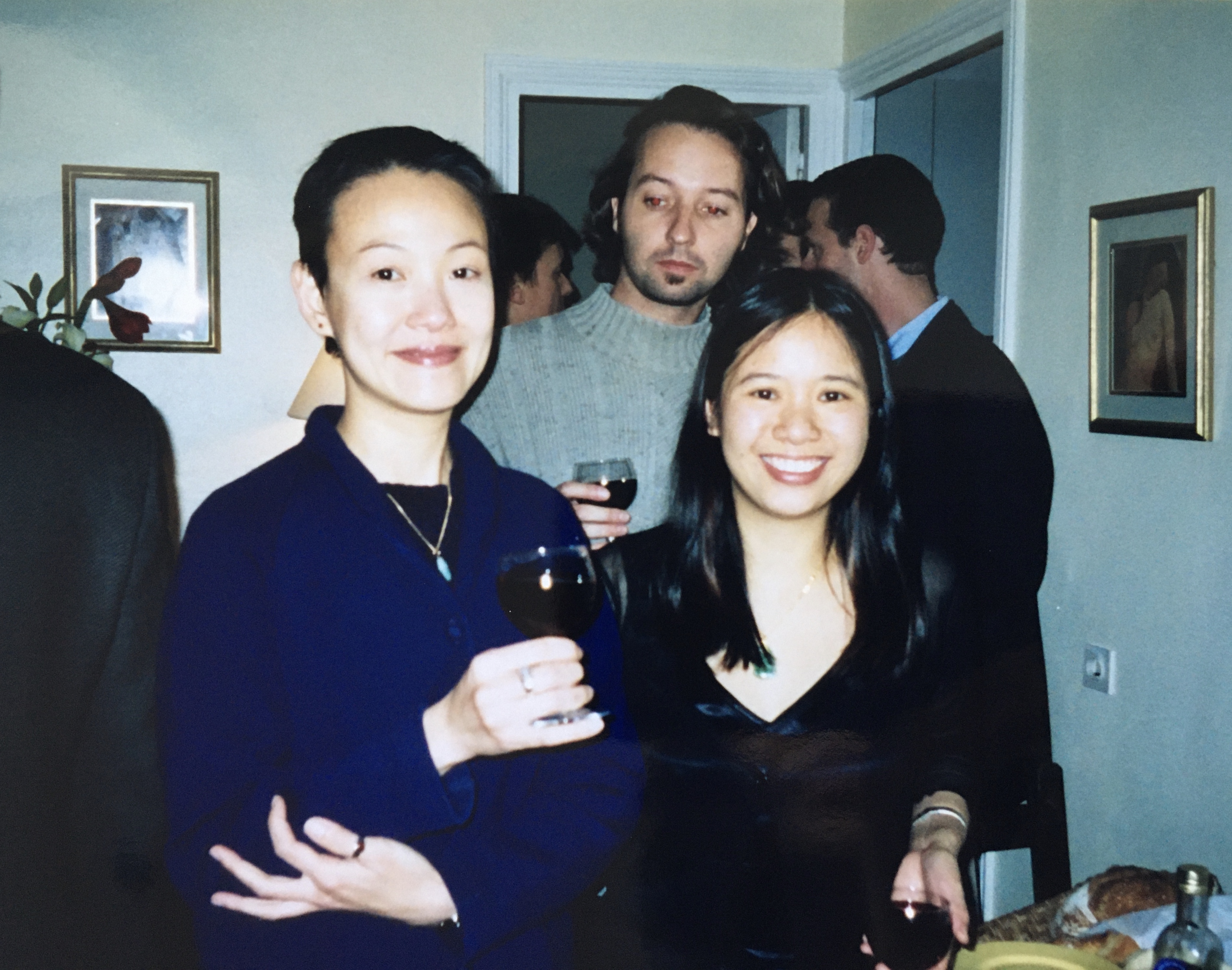
‘Of course’ Beth is there at that party in Paris…she’s one of the most magical people I know. She lives within very strong currents of serendipity—when one hangs around with her, weird, uncanny stuff happens. We did some research for our opera in Penang during the Hungry Ghost Festival on a trip funded by the Adelaide Festival (when Australian arts festivals had more money for new Australian work and believed in it as some kind of core cultural ‘good’). Anyway, with Beth there was always some spirit mischief afoot: shamanic messages delivered via unexpected channels; pirates, mermaids and other strange and glamorous denizens of the inter-worlds nearby (ok, we were staying in this old ramshackle colonial-era hotel in Georgetown that we gradually figured out was a front for a brothel). For an extraordinary, excessive/’preposterous’ co-reading of Beth’s book The Crocodile Fury and of my music, check out Tyler Bouque’s essay swarming: Beth Yahp’s “The Crocodile Fury” and the music of Liza Lim, (Substack, 13 Sep 2023).
Beth Yahp: To me, Paris and Moon Spirit Feasting are inextricably entwined. I was imagining being stranded on the moon with a peach tree, an old man, and a rabbit for company – like Chang O, the moon goddess at the heart of Liza’s opera – and Paris in winter supplied the grainy grey cold for this. Something about its crisp dry air, so unlike Sydney in winter, or Kuala Lumpur anytime, and the loneliness of not speaking French, of feeling muted, curtailed, navigating a girded city with messier maps in mind. The loneliness of no one knowing me brought certain pleasurable freedoms – like wearing a long black-haired wig over my Wong Faye circa Chungking Express haircut. Its smooth tresses swished down my back as I cultivated ghostliness, flitting past the cluttered Chinese cloth shops on rue du Chemin Vert or rue Sedaine, and someone asking, “Vous êtês japonaise?” When Liza comes to town, she’s the calm centre towards which a convergence of artists, musicians, composers, music, ideas, and conversations are drawn. It’s her other superpower, her ability to draw from others, in my case certainly, what’s bigger and deeper than we imagine we have. I remember the warmth of that party in the Marais, hearing Australian voices for the first time in a while, hearing Xenakis for the first time on another visit, and other moments of acute attentiveness. Like that time in the noisy chaos and incense smoke of the impromptu street-opera in Penang, when Liza tilted her head and asked, “Do you hear that bell?” I hadn’t then, and in Paris when Liza visits, I stop flitting and start listening. I hear swarming and buzzing, a goddess who’s maybe more mad than sad at being lonely and cold. I hear her voice, and her words follow.
Cathy Milliken
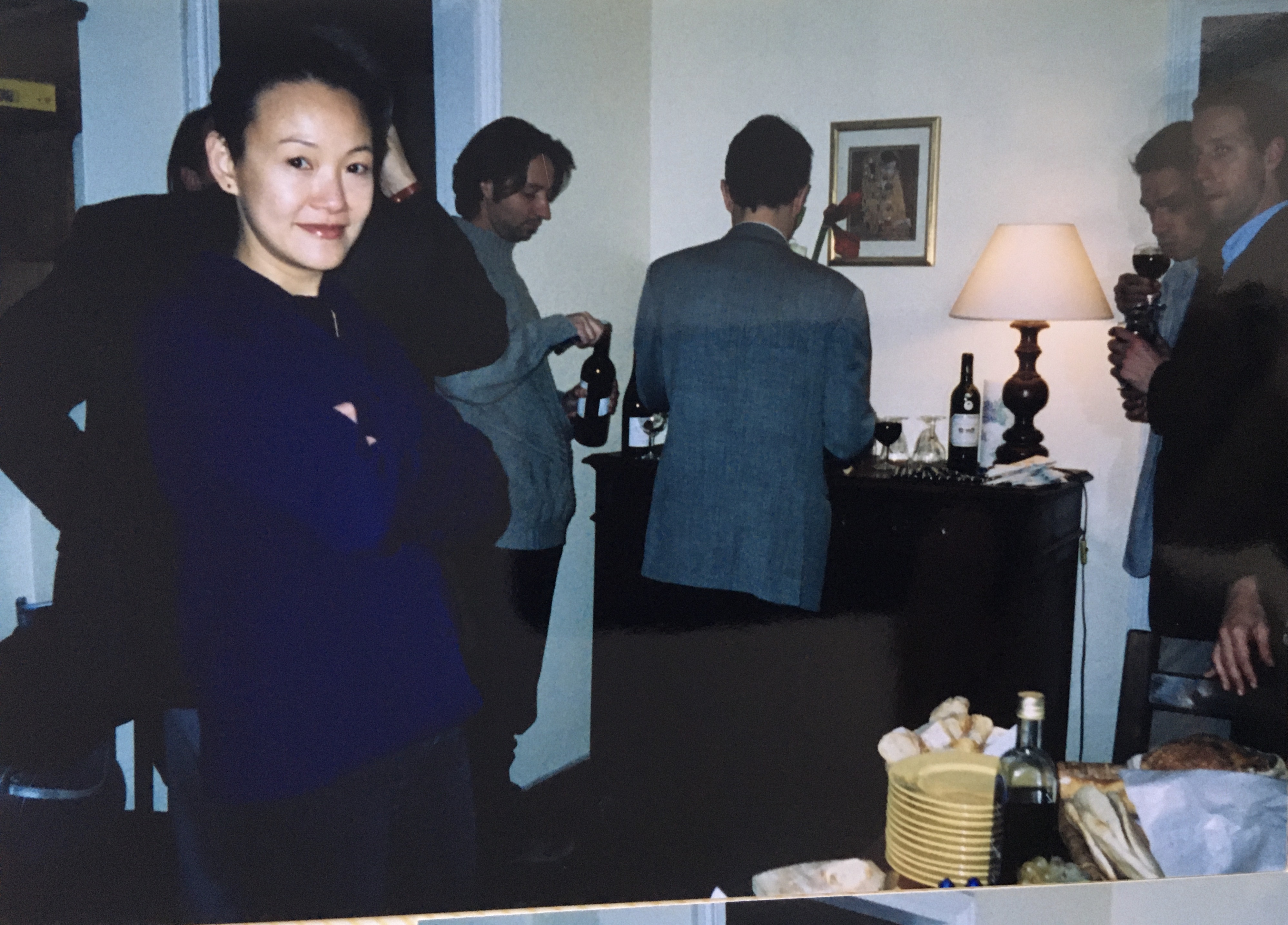
Another person who happened to come to that party in Paris was Cathy Milliken. Cathy has been a mainstay of my creative life, someone I’ve always looked up to with awe. She was a role model, being of an earlier generation of artists who left Australia for Germany and who established amazing careers at the very pinnacle of European music-making. (Brett Dean was another in that ‘cohort’ of musicians who left Brisbane suburbia for a cosmopolitan life of music). ‘Home’ becomes a multiply faceted thing of ‘chosen families’. Best composition advice from Cathy: ‘write into the void’ (see below).

Composer, oboist, creative director extraordinaire, Cathy Milliken smouldering next to the crudités, Paris 1999 (photo: L.Lim)
Cathy Milliken: The Click, a definition. Just sharing a thought on “being in click”. I use this phrase to refer to the times I feel compositionally and emotionally on the same wavelength as my present musical place and people. This means sharing concerns and also feeling that what excites me seems to excite others and finds immediate resonance. Life hums! Being “out of click” is a darker lonelier state. I have also called it composing into the void. It’s confronting but artistically strengthening. One’s resolve is thrown into focus. Although feeling no longer hyper fleet-footed but instead slow-footed and dark-tested, one wills oneself into contemplation, revels in quiet foraging, shunning in fact the fleet footed “click into”.. until the heavens open again. One “clicks into” again, high flying until the next plunge!
 Liza Lim