
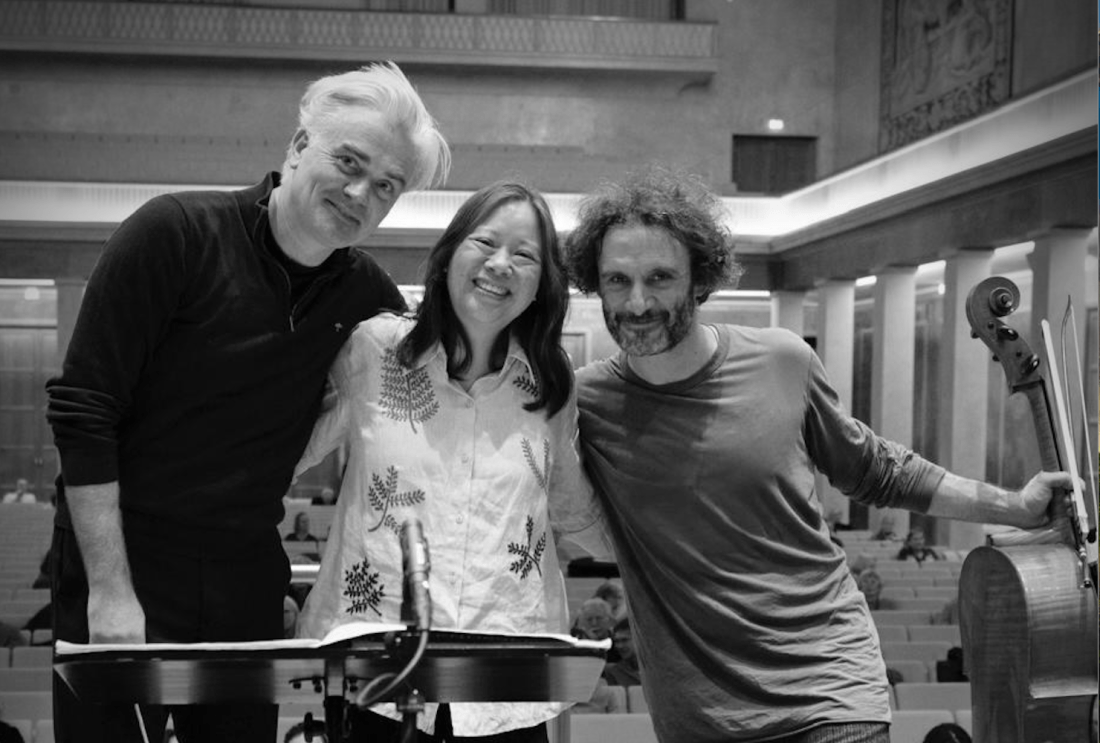
I had a truly lovely day today, taking in the news that I’ve won the Grawemeyer Award for Music Composition, for my cello concerto A Sutured World. It’s an incredible honour, and I’m grateful for the coverage from outlets like The Violin Channel, Limelight, and the University of Sydney. First thing this morning, I spoke with Daniel Gilliam on WUOL radio—his thoughtful questions brought back some vivid memories.
Of course, it’s humbling to be counted among personal heroes such as Harrison Birtwistle and Krzysztof Penderecki. But what really surfaced for me were the deep impressions two particular prize-winning works made on me when I was a young composition student.
I remember so clearly hearing Chinary Ung’sInner Voices, awarded the 1989 Grawemeyer, broadcast on ABC Radio. The way the piece uses lyric line to shape musical form captivated me and the ethereal ending with the solo violin is breathtakingly beautiful; its lyricism brought an emotional core I hadn’t encountered in other new music. And the fact that Chinary was an Asian composer mattered enormously: it signalled that there were pathways for someone like me to participate in a new music world that was dominated by Europeans.
The following year, Joan Tower won for Silver Ladders—and again, thank you ABC Radio for keeping us informed in those pre-internet days! Even though my sense of feminism was rather inarticulate in my early 20s, it resonated deeply to see a woman composer receive such recognition. Listening to the work again now, I hear fascinating connections to Ung’s piece: the solo oboe line, the marimba’s shimmering rolls, and other striking solos—low contrabassoon, the trumpet near the end!—woven into virtuosic zigzag lines, bold rhythms, and an orchestra bursting with colour. It’s a true concerto for orchestra, and I especially love how it closes on a glowing resonance.
Maybe it was the early hour, when one’s defences are a little looser, but my conversation with Daniel made me realise something else: my usual description of the work’s genesis as being ‘about a suturing or stitching together of broken pieces’ is slightly out of order. Before that metaphor emerged, I first recalled the sensation of hearing Nicolas Altstaedt’s cello sound—sheer beauty, like a golden thread—and asking myself what that beauty might confront in my music.
So, my early encounters with Grawemeyer-winning music intersected with deep resonances around identity and representation. Chinary Ung’s and Joan Towers’ works didn’t just inspire me—they expanded my sense of what was possible. Today, I feel deeply the joy and privilege of working with phenomenal musicians like Nicolas Altstaedt, with conductor Ed Gardner, and with the orchestras (Bavarian Radio Symphony Orchestra, Royal Concertgebouw Orchestra, Melbourne Symphony Orchestra, Orquestra Sinfónica do Porto Casa da Música) and organisations (Musica Viva Munich, Cello Biennale Amsterdam, Casa da Música) that commissioned A Sutured World and helped bring it to life. I’m profoundly grateful for the University of Louisville’s stewardship of the Grawemeyer Award, which affords me the privilege of connecting to important lineages in music-making over the last four decades. This lineage isn’t just history—it’s a living conversation, and I’m excited to keep adding my voice.
[photo credit: Edward Gardener, Liza Lim, Nicolas Altstaedt, photo (c) Astrid Ackerman]
 Liza Lim